“He shaped our profession and guided our college.”
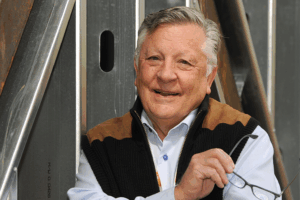
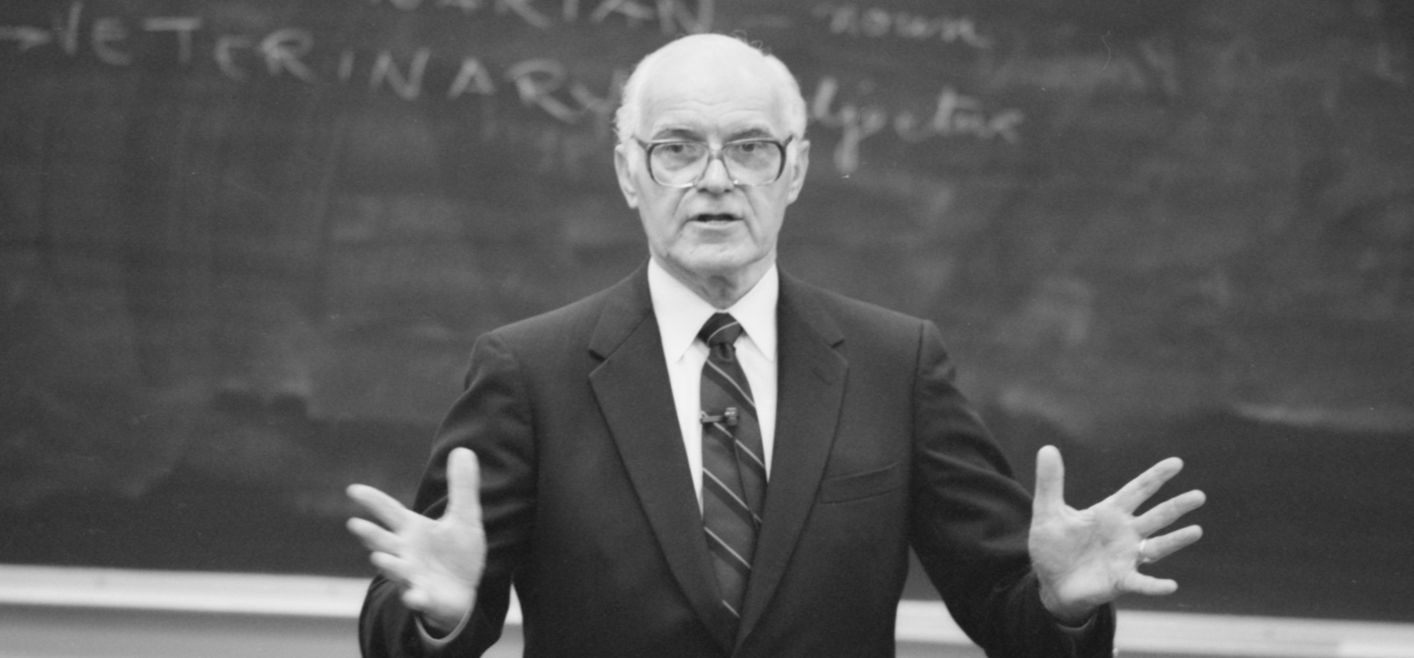
That is how Dr. Ed Claiborne (CVM ’80) describes Dr. Willis William (W.W.) Armistead, founding dean of the UT College of Veterinary Medicine.
Armistead did that, and much more. He actually guided three veterinary colleges, serving as dean at Texas A&M University from 1953-57 and then at Michigan State University from 1957-74 before being appointed founding dean at UTCVM in 1974. Armistead took the helm of the University of Tennessee Institute of Agriculture in 1979 as the 2nd vice president of UTIA, a position he held until his retirement in 1987.
A consistent leader in the profession, Armistead was very active throughout his career in the American Veterinary Medical Association (AVMA), serving on its Board of Governors, Judicial Council, Joint Committee of Veterinary Education, and as president from 1957-58. He was a founding member and two-term president of the Association of American Veterinary Medical Colleges, where he also chaired the Committee on Professional Education. He was a member and president of the Texas, Michigan, and Tennessee Veterinary Medical Associations, and served in several other health profession and education organizations at the local, state, and national levels. His first publishing experience was in 1938 when, as a veterinary student at Texas A&M University, he was appointed art editor for student publication, The Battalion. He advanced to the position of associate editor of the Journal of the American Animal Hospital Association (1964-70) and editor-in-chief of the Journal of Veterinary Medical Education (1974-80).
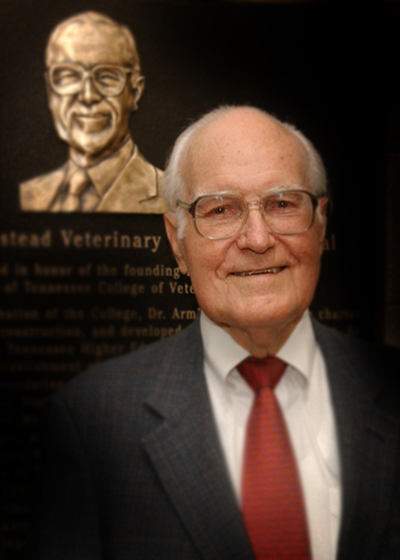
W.W. Armistead was a respected representative of, and a well-recognized voice for the veterinary profession and was asked to serve in an advisory capacity for more than twenty-five state and national organizations. Most notable of these assignments included national consultant for the U.S. Air Force Surgeon General (1960-62); consultant for the White House Conference on Health (1965); and consultant for feasibility studies for the establishment of veterinary medical schools in Connecticut, Wisconsin, Florida, and Tennessee. He served on the Board of Directors of the Tennessee Farm Bureau Federation and of the Tennessee 4-H Club Foundation.
erhaps Armistead’s most significant impact on the veterinary profession began in May 1973, when he was asked by the Tennessee Higher Education Commission to conduct and lead a feasibility study for the establishment of a veterinary medical school in Tennessee. His report to the state legislature on the prospects for a veterinary college ultimately became the planning document for the design and construction of our veterinary college. On January 31, 1974, TN Senate Bill No. 1522 authorized the Tennessee Higher Education Commission to establish the College of Veterinary Medicine at the University of Tennessee in Knoxville and to begin operations no later than September 1976. Armistead was appointed dean, and the rest is our history.
“He did far more than watch and approve what the architects and builders did,” says Armistead’s son, Jack. “He actually drew up first drafts of the floor plans, traffic flow patterns (human, animal, and vehicular), and equipment specifications that would be needed. But his vision did not stop there.” Jack recounts his father’s design of the three-year curriculum that was used at UTCVM from 1976-89: “I’m sure you already know about his vision for a reformed curriculum, now, I suspect, a thing of the past.” Armistead was far ahead of his peers when, starting in the 1970s and extending into the next three decades, he identified the rising cost of veterinary medical education as a major threat to the profession. The primary goal of Armistead’s three-year curriculum was to contain these costs for the benefit of the students, the college, and the state. In Armistead’s words, “There is nothing magical or sacred about the use of four years as the standard for university degrees. It is time that veterinary educators, increasingly pressed by spiraling costs and too little time, begin to think outside the box of traditional curriculum formats.” (JAVMA, Vol 221, No. 12, December 15, 2002).
Another issue for which Armistead “thought outside the box” was conventional veterinary curricula. In a 1972 address to the profession (Practicing Veterinarian 44[4], p. 20-22), he cited a critical need for “innovation and experimentation in veterinary medical education, improved methods of teaching and evaluation of student progress, increase curriculum flexibility to provide more options for the student, and greatly expanded programs for post-DVM education.” His call for “increasing dependence of the veterinary medical school upon federal support” in order to decrease the funding gap that he predicted would occur due to “inadequacy of state appropriations” were prophetic of the critical issues that our profession is wrestling with today.
Armistead’s leadership skills were legendary among those who knew and worked with him. Most significant in this regard was his selection of the first nineteen members of the UTCVM administration and faculty. His ideals for the conduct and appearance of veterinary faculty were clearly articulated, and he hand-picked individuals who shared his values for teaching excellence and professionalism to guide the college through its formative years. He chose well, and the college today still enjoys a reputation as being a place where teaching is job number one, and collegiality is a core value. His well-known and uncompromising standard for excellence was best illustrated to me when, in welcoming a new class of students to the CVM, he told them that “among other things, you will learn that ‘VETERINARIAN’ is a six-syllable word.” He was not hesitant to correct anyone at any time who mispronounced the name of his profession.
For those who did not know him well, Armistead’s professional demeanor sometimes overshadowed his approachability, witty sense of humor, and persistent optimism. The first time I met him we were attending the wedding of a mutual friend. I was a resident in internal medicine at the University of Georgia, while he was one of the most respected individuals in the profession and a three-time dean of international reputation. Armistead walked up and introduced himself. He inquired about my training, my professional goals, my family, and my interests. He made me feel like I was the most important young veterinarian in the country. He was genuine. That is the kind of person he was, and it occurred to me at the time that he would be a great person for whom to work. I did not realize that the recruitment process had already begun.
Dr. Jack Armistead shared a glimpse of his father as a young man and family man. “He was a great lover of dogs, music and musical comedies, movies, and automobiles. He had a wonderful singing voice and could tap dance like a vaudevillian. He and his brother, as older teenagers, performed on the vaudeville stage in Houston, Texas—he played the violin, his brother played the piano, both tap danced and sang. He was a gifted draughtsman and artist as well as an accomplished writer/editor. As a student at Texas A&M, he was a popular cartoonist for the college magazine, and early in his academic career he illustrated medical books, especially those dealing with surgery.”
Armistead entered practice in Dallas, Texas, in 1938, but left to join the faculty of Texas A&M University’s CVM in 1942. Shortly thereafter, he took a leave of absence to serve as a Major in the Army Veterinary Corps from 1942-46, serving in Oklahoma, North Africa, and Italy. He remained in academia for the duration of his career as one of the most influential veterinary medical educators in the history of the profession.
UTCVM History of Deans
Dr. W.W. Armistead was the founding dean at UTCVM, serving from 1974 until 1979 when he was named Vice President of UTIA, then retiring in 1987.
Dr. Charles F. Reed
Interim Dean 1979-1980
Dr. Hyram Kitchen was named the second dean of UTCVM in 1980, until his death in 1990.
Dr. Michael Shires was named the third dean of UTCVM in 1990, after serving as interim dean for 10 months. He then served for 10 years, and retired in 2000.
Dr. Michael Blackwell was named the fourth dean of UTCVM in 2000. He served for 8 years until his retirement in 2008.
Dr. Leon N.D. Potgieter
Interim Dean 2008
Dr. James Thompson was named the fifth dean of UTCVM in 2008. He served as dean until his retirement in 2023. With 15 years of service, he is the longest serving dean at UTCVM.
Dr. Robert DeNovo
Interim Dean 2024
Dr. Paul Plummer was named the sixth dean of UTCVM in 2024. He is a UTCVM alumni and his first day acting as dean was July 27th, 2024.
Explore More on
Discovery
MORE FROM THIS ISSUE