UTCVM Faculty Answer Questions in The Conversation
The Conversation is a nonprofit, independent news organization dedicated to unlocking the knowledge of experts for the public good. They publish trustworthy and informative articles written by academic experts for the general public and edited by their team of journalists.
In the last year, two UTCVM faculty were asked to answer questions as a part of The Conversation’s Curious Kids section. Curious Kids features interesting answers from experts to questions children have from all around the world.
Why do cats’ eyes glow in the dark?
– Chloe, age 10,
Barkhamsted, Connecticut
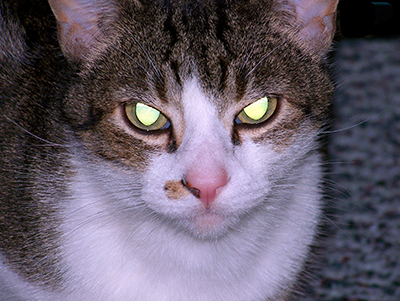
Cats and many other animals, including most dogs, can reflect light from their eyes. That’s why cats’ eyes will usually shine brightly in photos taken in a dimly lit room or glow when illuminated in the dark by a flashlight or a car’s headlights.
Species whose eyes glow have evolved to see better in low light because they either forage or need to look out for predators throughout the night, or they do most of their hunting at dawn and dusk. In fact, domesticated cats can see in conditions that are only 16% as bright as what people require.
Cats accomplish this because their pupils – the openings that appear black in the middle of their eyes that widen and narrow in response to light conditions – are special. Pupils operate like windows, with bigger ones letting more light into the eye. And a cat’s pupils can become up to 50% larger than human pupils in dim light. They also have a higher number of a specific type of light-sensing cell in the back of their eyes than we do. These cells, called rods, catch low-level light.
The tapetum lucidum
In addition to having large pupils and lots of rods, cats have something people don’t: a tapetum lucidum, a Latin medical term that translates to “bright or shining tapestry.” The tapetum lucidum is also known as “eyeshine.”
It’s located in the back of the eye behind the retina – a thin layer of tissue that receives light, converts the light to an electrical signal and sends this signal to the brain to interpret the image.
A cat’s tapetum lucidum is made up of cells with crystals that, like a mirror, reflect light back to the retina. This gives the retina a second chance to absorb more light.
The feline tapetum lucidum is special because its reflective compound is riboflavin, a type of vitamin B. Riboflavin has unique properties that amplify light to a specific wavelength that cats can see well, which greatly increases the sensitivity of the retina to low light.
In cats, the tapetum most often glows yellow-green or yellow-orange, but the color varies, just like their irises – the colorful part of their eye, which can be green, yellow, blue or golden. Variation in tapetum color is not unique to cats and can be found in lots of species.
Most dogs’ eyes will glow in dark spaces when a light shines on them.
Other animals’ eyes glow too
Many other animals that need to see at night have a tapetum lucidum. That includes predators and prey alike, everything from wild foxes to farmed sheep and goats.
The tapetum lucidum is also useful to fish, dolphins and other aquatic animals, because it helps them see better in murky, dark water.
In land animals, the tapetum is found in the top half of the eye behind the retina, because they need to see what is on the ground best. But in aquatic animals the tapetum takes up most of the eye, because they need to see all around them in the dark.
Like cats, the lemur, a small primate, and its close relative, the bush baby – also known as a “night monkey” – also have a superreflective tapetum made with riboflavin.
Even though a lot of animals have eyeshine, some small domesticated dogs lack this trait. Most animals with blue eyes and white or light-colored coats have also lost this trait.
So don’t be alarmed if your dog’s or cat’s eyes don’t glow. The list of other species without a tapetum lucidum includes pigs, birds, reptiles and most rodents and primates – including humans.
This bush baby can probably see better at night than you can.
Is there a downside?
Unfortunately, animals with a tapetum lucidum sacrifice some visual acuity for their ability to see in dim light.
That’s because all that light bouncing around as it reflects off the tapetum can make what they see a little fuzzier. So, a cat needs to be seven times closer to an object to see it as sharply as a person would in a brightly lit place.
But don’t worry, I’m sure your cat would rather see clearly at night than read a book.
– Dr. Braidee Foote
UTCVM Ophthalmology
https://theconversation.com/why-do-cats-eyes-glow-in-the-dark-179531
How many bones do penguins have?
– Sawyer, age 7, Media, Pennsylvania
As a zoo and wildlife veterinarian, I sometimes take care of penguins – both in the wild and in aquariums and zoos.
I’m always fascinated when I have to take X-rays of an injured bird that might have a broken bone, is sick or having difficulty moving. While penguins might look like simple, torpedo-shaped ice-waddlers, their bodies are actually quite complex.
Even though they look nothing like people or animals you may encounter every day – like dogs and cats – they have similar skeletons and joints. They even have knees and elbows, but have about half as many bones. A human skeleton is made up of 206 bones. A penguin has just 112 in its whole body.
All birds evolved for flight, with feathers, wings and a body that allows them to soar high in the sky. To attain liftoff, over time penguins evolved to have fewer bones in their skeletons.
How did they do that? Some of their bones actually fused together, including their ankles. Unlike humans, who have two main ankle bones, a bird’s leg bone connects directly with its feet and toes.
Birds also have fewer bones in their spines than many animals. Their lower back bones joined together into just one bone, called the synsacrum. The only other animals to have this type of backbone were the dinosaurs. For the birds, this helps them keep their bodies in a horizontal position without tiring out their back muscles while flying or swimming.
Bird bones in general are unique. They are lightweight and hollow, which allows the animal to take flight. Because birds need a lot of oxygen for an intense activity like flying, their bones are filled with spaces for air and they also have nine air sacs that surround their lungs.
But wait, you might be thinking, “Penguins don’t fly at all.” That’s right, they evolved for a life on land and in the water, and they have a unique skeleton compared to many other birds.
The first penguins, which appeared shortly after the dinosaurs went extinct about 66 million years ago, were flightless. Ten million years later, they had become great swimmers. Present-day species spend up to 75% of their time in the ocean. That meant they had to grow heavier so they could dive underwater to hunt for food.
Penguins developed dense, hefty bones that don’t have the air pockets that flying birds have. That helped make up for the air sacs around their lungs. Their bulky bones keep them from floating up to the water’s surface, like a scuba diver who straps on a weight belt to submerge.
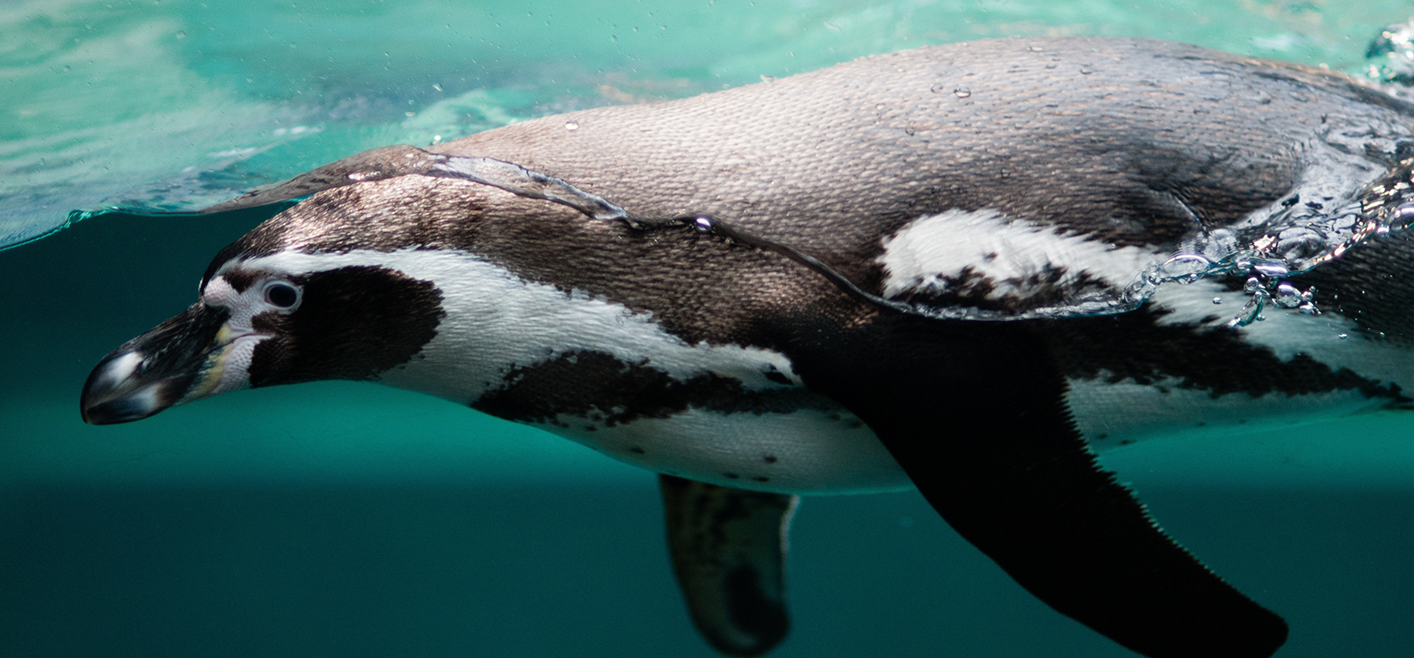
Penguins’ wings are also different because these birds need to swim, not soar into the sky. Penguins’ wings morphed into what look like short, flat, stiff fins that don’t bend like flying birds’ do. They also have fewer bones than other birds.
Their wings act like paddles, helping them race through the water at high speeds. Gentoo penguins can swim up to 22 mph. That’s much faster than Olympic champion swimmer Michael Phelps, who broke a world record for humans at 5.5 mph.
The combination of hefty bones and powerful finlike wings allows penguins to descend quickly and dive incredibly deep to hunt for fish, krill and other food. An emperor penguin can go down to at least 1,500 feet, which is about the length of five football fields.
Thanks to their fewer number of dense bones and other cool adaptations, penguins are champions of open water.
– Dr. Julie Sheldon
UTCVM Zoological Medicine
https://theconversation.com/how-many-bones-do-penguins-have-170252

Explore More on
CompassionKnowledge
MORE FROM THIS ISSUE