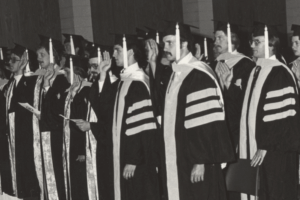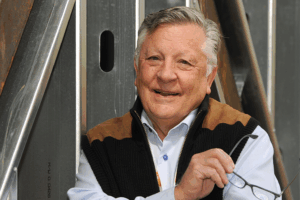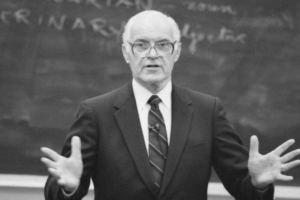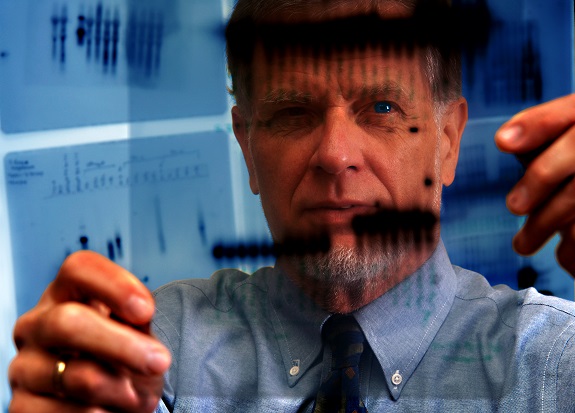
David Brian, an inspirational professor, mentor, imaginative cook, and researcher, joined the UT College of Veterinary Medicine as its first faculty member in 1976. The rural Michigan native, who earned a DVM and PhD from Michigan State University, was a pioneer in the field of virology. Sadly, Brian passed away in 2014. However, he left a legacy of scientific work that will continue to propel the work of the research community.
As one of the college’s first faculty members, Brian developed a veterinary virology course as well as a research program focused on the coronavirus family—well before strains of the virus made SARS and COVID-19 the subject of headlines. With resources from the UT Department of Microbiology and UTCVM, he was able to open his own lab with an emphasis on virology research.
“Coronavirus was important at that point, but there wasn’t very much known about it, so it was a beginning field,” said Donna Brian, who was married to David Brian, in an interview with Manchester College. “When he started out he was studying diarrhea in baby pigs that was caused by coronavirus.”
That initial research led to a wealth of knowledge. When a SARS outbreak happened in 2002, it was Brian who was quoted in multiple national publications on his perspective on how these viruses spread from one species to another. Brian and his team later worked with the Centers for Disease Control and Prevention to identify a new SARS strain in 2003. Brian sought to design a sequence-based diagnostic kit that would test for a certain strain and help mitigate the spread of the virus. He and his team received national recognition for their contributions.
“Veterinarians have known for a long time that coronaviruses can cause very, very nasty diseases,” said Brian, in a 2003 interview with DVM360. “We’ve often said if anything ever happened in humans that would mimic any of these diseases in animals—pigs, cats, chickens, or cattle—it would be a major public health problem. Here it is.”
And it wouldn’t be the last time a coronavirus caused a major public health problem. It would make headlines again years later, this time as COVID-19. When the pandemic hit, Brian’s work became more important than ever. It served as the foundation for multiple COVID-19 protocols and findings, and it still serves researchers today, as they continue important discovery work around the virus.
Brian’s legacy also continues in the classroom. His career is marked by not only his notable published works on the coronavirus, but by the legacy of the researchers whose careers he helped to grow. Known as “Doc”, Brian mentored multiple graduate students and postdoctoral fellows, many of whom thought of him as a second father. At least four of his doctoral graduates have become faculty with funded research programs at other universities. Brian was an example of what a professor could be; he held the values of UT highly. He was connected with students and was always learning. He was a true Volunteer.
MORE FROM THIS ISSUE