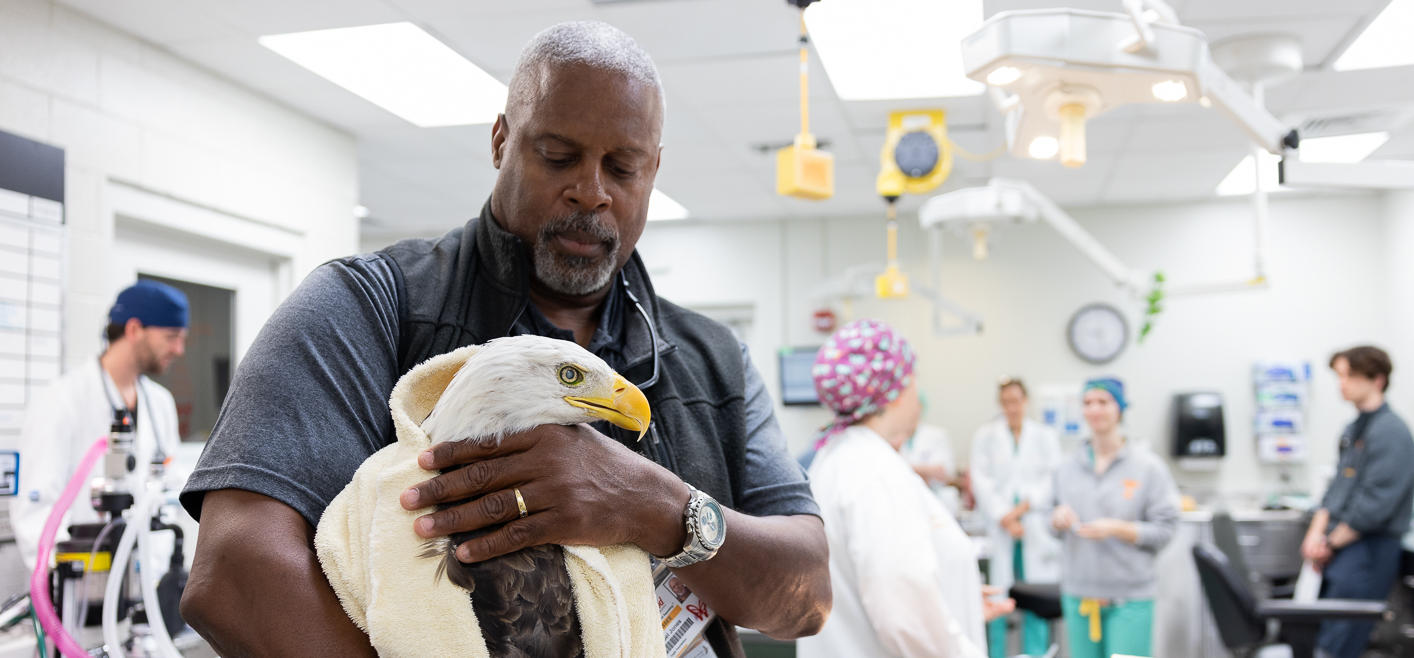
Twenty-five years after UTCVM performed the first cataract surgery on a bald eagle, the Nation’s most famous bald eagle educational ambassador, underwent eye surgery.
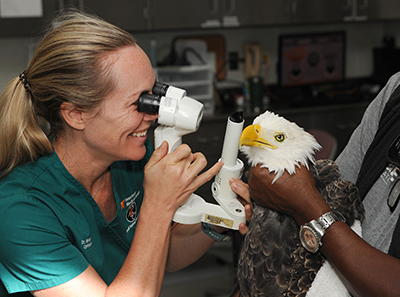
Challenger, the iconic bald eagle who has long been a soaring emblem of wildlife conservation, recently embarked on a different kind of flight – one toward better vision. The avian ambassador underwent life-enhancing phacoemulsification (cataract surgery) at the University of Tennessee College of Veterinary Medicine (UTCVM), in June. While it was Dr. Braidee Foote’s first cataract surgery on a raptor, it wasn’t the first at the college. In 1999, then veterinary ophthalmology resident, Dr. Barbara Cawrse performed the first cataract surgery on a bald eagle.
As an eaglet, Challenger was blown from his nest in 1989. Well-meaning humans found him and cared for him. His rescue saved his life but altered his destiny — he imprinted on people and couldn’t be released into the wild. Authorities took him to the American Eagle Foundation (AEF) which cares for and rehabilitates birds of prey. The foundation has released over 190 eagles back into the wild.
Since 1991, Challenger helped AEF educate people about the plight of the bald eagle which had been added to the Endangered Species List in 1978. Trained to free fly, Challenger soared over many events including a presidential inauguration, the World Series, NFL Pro Bowls, NCAA College Football National Championships, Neyland Stadium, and the Daytona 500. Challenger was at the White House ceremony when bald eagles were removed from the Endangered Species List in 2007. Many of Challenger’s historic flights and appearances can be found on the AEF YouTube channel.
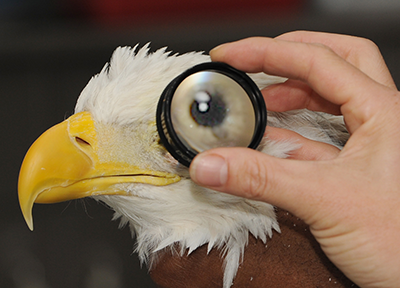
The staff at American Eagle Foundation closely monitor the health of over 80 birds of prey. With routine assessments and physicals, Challenger was retired from free-flighted programs due to the onset of cataracts in 2019. Just like humans, animals can also develop cataracts. Over time, these cataracts have gradually impacted Challenger’s day-to-day quality of life. An expert in the veterinary care of raptors, Dr. Michael Jones has been Challenger’s veterinarian for close to thirty years. When he retired from UTCVM in 2022, he joined AEF where he continued to treat Challenger. “We noticed that he wasn’t doing some of the normal activities in flights that we were expecting to see.” The altered behavior was a telltale sign: “When he couldn’t see as well, he was maybe going to people that he should not have necessarily gone to or that he didn’t recognize.”
After careful consideration and consultation with avian care staff, veterinary experts, and organizational leadership, AEF decided to proceed with cataract surgery; it was time to give Challenger eagle eyes once more.
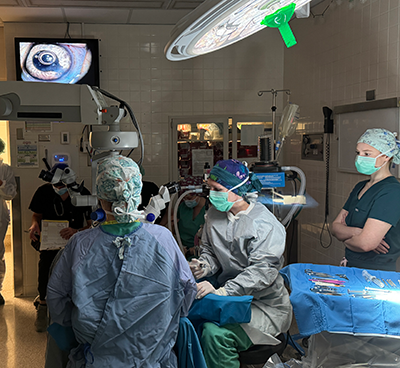
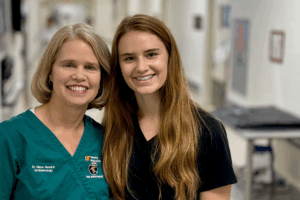
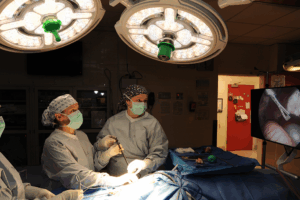
Ophthalmologists at the University of Tennessee College of Veterinary Medicine (UTCVM) evaluated Challenger and determined he was a viable candidate for the cataract procedure. Dr. Braidee Foote, an ophthalmology specialist at the veterinary college, was honored to serve as Challenger’s surgeon. “He is an American figure and symbol of wildlife conservation at its best. Cataracts can significantly diminish the quality of life, especially for these majestic birds who depend heavily on their vision. We were hopeful for a successful outcome that would improve Challenger’s vision.” Challenger’s medical team also included specialists from UTCVM’s zoological companion animal service and anesthesia service.
Surgical intervention is never without risks. However, all indications suggested that this surgery was a necessary step in safeguarding Challenger’s continued quality of life. “This surgery is more than a medical procedure,” says Jessica Hall, AEF executive director. “It’s about giving back to an individual who has inspired countless others across our nation. We are committed to providing the highest level of care and ensuring Challenger’s story continues to inspire us all.”
Challenger has soared through his recovery. His next recheck at UTCVM is scheduled for October. While he remains retired from free-flighted programs, the bald eagle is again spreading his wings and flying in his aviary at AEF in Kodak, Tennessee.
MORE FROM THIS ISSUE