Veterinary Neurologist on National Television
Q&A with clinical assistant professor Talisha Moore
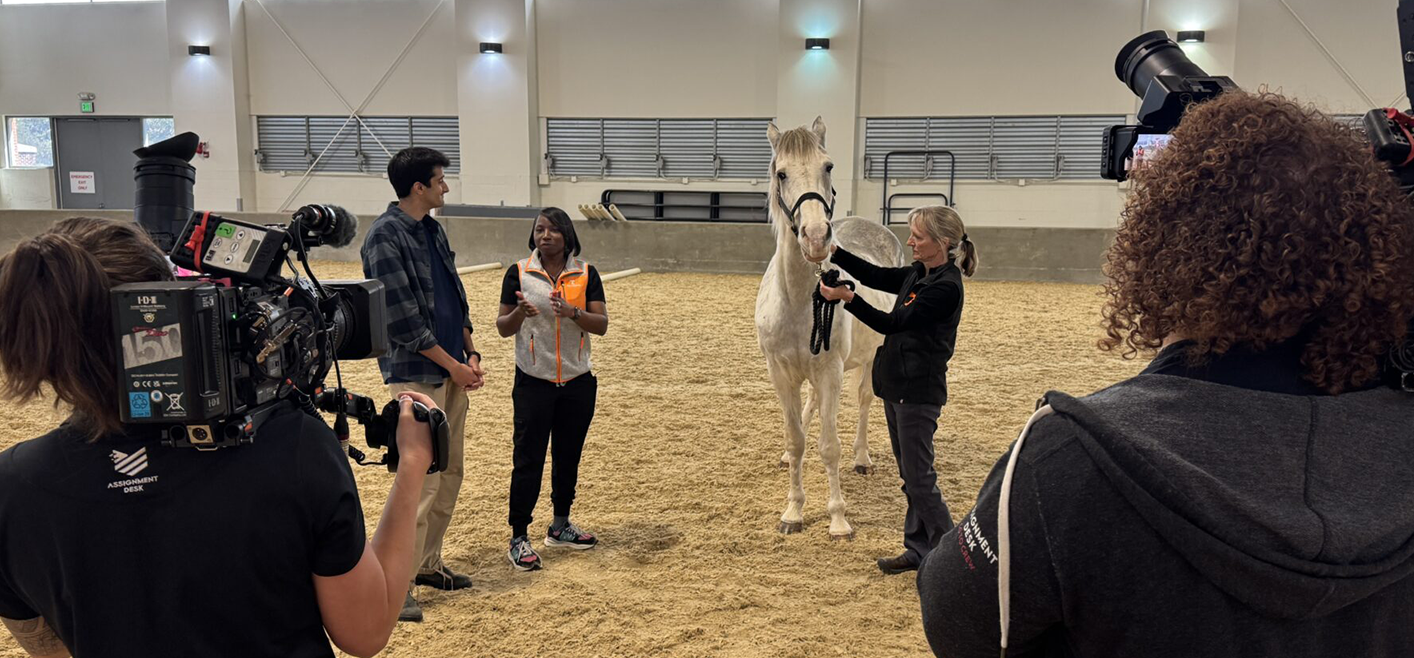
In a long twelve-hour day, Talisha Moore was out of her comfort zone. The clinical assistant professor of veterinary neurology is the center of a Mission Unstoppable seventh-season episode that aired on CBS on October 4, 2025. The show spotlights female science, technology, engineering, and math (STEM) superstars who dominate their fields and show young viewers how these inspiring women are unstoppable.
What was it like being on CBS-Mission Unstoppable?
Being on the Mission Unstoppable was intimidating and felt like a high-stakes situation. There were so many cameras, lights, and the microphones were in a perpetual ‘on’ state. The latter made bathroom breaks a bit uncomfortable. I am my own worst critic, so I was disappointed when I did not get it right on the first take. However, once I moved past the initial nervousness and gave myself grace, I enjoyed the experience, although it was an exhausting day. I finished the day with a newfound respect for people in the television and film industry. Recently, the production team sent a preliminary look at the television episode. It is amazing how approximately fourteen hours of raw footage was condensed to approximately six minutes. And, most impressive, is how well the footage was edited, creating a seamless episode. I also developed a newfound respect for people behind the scenes editing the raw footage. Ultimately, it was a fun experience, though I do not think I am destined to be a movie star. Most important to me is that this episode impacts at least one child, inspiring them to explore and perhaps pursue a STEM career, even if it is not veterinary medicine.
What role did STEM play in your life when you were growing up?
Since I can remember, science, technology, and mathematics have been a guiding force in my life. My mother is a retired registered nurse. During my adolescent years, she was a surgical scrub nurse. At the age of thirteen, I volunteered in the recovery room at the hospital that employed her. Because many of the doctors knew I was her daughter, they would allow me into the operating room to quietly observe procedures. Although I had numerous exposures to STEM by that point, I am certain this exposure was the unintentional foundation to my STEM career. Specifically, science and mathematics became second nature to me, and I excelled in both throughout my academic career. The latter, combined with my love for animals, solidified my path into veterinary medicine. That said, had I not pursued veterinary medicine, I would have pursued a career in psychology or psychiatry, a social science.
Why is STEM important?
This is difficult for me to articulate, but in my opinion, science, technology, engineering, and mathematics are what allow society to progress. To me, it’s just that simple.
How do you help youngsters engage in STEM?
Early (veterinary school, internship, and residency) in my career, I frequently volunteered at local and regional Boys & Girls Club of America with the goal of exposing under-served and minority children to veterinary medicine via chats, show –and tell, and when feasible, hands-on experience. After a brief hiatus, I now participate regularly in the University of Tennessee College of Veterinary Medicine Virtual 4-H Vet Science Club (4-H VSC) and Veterinary Summer Experience Program (VSEP). The 4-H VSC is an online program created in partnership with the Tennessee 4-H Program, is designed for students in fourth through twelfth grade, and aims to introduces youth and their families to the diversity of veterinary medicine and animal science at UT. My understanding is that this program has reached over 300 students across 75 Tennessee counties. The VSEP targets rising high school juniors and seniors and provides them with an immersive experience in the world of veterinary medicine. I have provided online content regarding veterinary neurology for 4-H VSC, in-person chats, and question-and-answer sessions for the VSEP. Additional outreach included regional (Tennessee STEM Explorers) and national (CBS–Mission Unstoppable) television shoots highlighting STEM careers with target audiences of kids between ages eight and eighteen.
MORE FROM THIS ISSUE